This post originally published in NRI Pulse May 2015
Leslee Udwin’s Passion Translates Justice-Seeking to Filmmaking
- Leslee Udwin shopping at Squash Blossom in Decatur, GA. Photo courtesy Neha Negandhi.

BY NEHA NEGANDHI
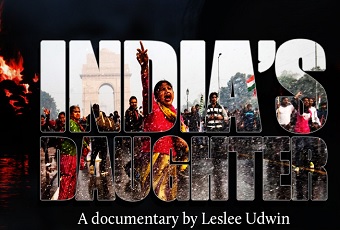
Atlanta, GA: So much has been written about the powerful documentary ‘India’s Daughter’ and its ban by the Indian government. And then there are the lengthy discourses about the filmmaker, Leslee Udwin’s audacity or awesomeness in making the film about the 2012 infamous gang rape and murder of a Delhi college student. But before the banning and before the protests, Leslee Udwin was an award-winning producer and before that, a successful theatre actress. But it is not the accolades that Udwin uses as inspiration when she births a new visual story to life. Instead it is her upbringing in a patriarchal household, her unequivocal views about women’s rights and her extreme mindset – with no shades of grey allowed – which serve as the building blocks to use her voice.
During Udwin’s recent visit for Atlanta’s premiere of ‘India’s Daughter’ documentary screening, I got to spend 24 hours with the super-charged, boisterous, designer-shopping filmmaker extraordinaire and it was like experiencing a caffeinated high without a drop of coffee. Udwin’s intensity is infectious and enveloping and it’s no holds barred from moment zero. She makes no apologies for the entire traffic-ridden ride from Hartsfield airport to her press interview for sending texts, writing emails and scheduling calls with the head of Universal Studios but why should she? The time is now for her documentary to serve as a platform for women’s rights, gender inequality and ending sexual violence against women and if ever there was a person to give credence to these heady topics it is Leslee Udwin. Her entire life has been dedicated to waging wars against society’s oppressors and wrong-doers.
- Leslee Udwin (L) with Neha Negandhi (R) at PBA 30, Atlanta’s PBS Station. Photo courtesy Neha Negandhi.

“If it is a test for humanity, I will always fight for justice. I’ll stand every time for the common good, fight for what’s right and insist on basic human rights. Every time,” Udwin says.
Udwin was born in Israel, shortly thereafter though; her father uprooted the family and moved them to South Africa. Her father “a patriarchal Jew” insisted Udwin and her older sister attend an orthodox Jewish religious school explains Udwin as we sat outside a lunch café in a quaint Atlanta neighborhood called Decatur. Her first test, at age 13, was the ignition switch in her patriarchal regime battle when she insisted the school’s director mandate abolishing reciting the Morning Prayer, Shacharit. Udwin says the prayer is misogynistic because it states, “..has not created me a women” and when she told Father Tanza where to shove the Torah, it resulted in her immediate expulsion. She went on to secular school and succeeded even while continuing her rebellion by creating a gambling den in the back of the classroom with peers betting real money on card games. Though she earned her university degree in drama, it did not come with unconditional support from both parents.
“My father was absolutely dead-set against [me obtaining a degree in drama],” Udwin blisteringly said. Udwin’s father’s authoritarian ideals have deep-rooted connections in her life chapters; it lays a foundation from which she draws to tell her visual stories.
Moving to London after college graduation opened theatre doors and acting projects galore. “I was pretty damn good [at theatre acting],” Udwin admits in between bites of hummus and pita. She played roles at the prestigious National Theatre in London as well as Royal Court theatre and many more. Seemingly, all was well in Udwin’s life except when the silent, omnipresent patriarchal shadow came to life and this time, in the form of her unscrupulous landlord (in fact he was a convicted felon and one of Britain’s main criminal landlords). He was “merciless” in his tactics to get the rent-controlled tenants to vacate so he could sell the property for a huge profit. All the male tenants fled fearing for their lives. Udwin and the other single females remained. And by doing so, she challenged another patriarchal figure, so for twelve straight days and nights, she read the housing law volumes until she discovered the one piece of legislature that could get rid of the landlord for once and for all. A small aside: I was immensely impressed with Udwin’s memory when she recited the law section number and subsection, etc like the law volume was sharing the table with us. Her standing up to fight for justice set a legal precedent in the High Court of England and Udwin continued to build solid foundation in campaigning for human rights.
Her first foray into the televised arts was after her high court victory over the landlord. Deciding that the story had “a crucial message to deliver”, she consulted with a producer to make “Sitting Targets”, BBC Screen Two film. Her real deep-dive into filmmaking came from, yet another, justice-seeking project called “Who Bombed Birmingham?”.
At a party, Udwin was asked by the Birmingham Six Campaign Group to look into six men who were wrongfully convicted of bombing mainland Britain by IRA, based on police brutality and subpar judges. She championed the cause because it is “the greatest miscarriage of justice” to deny six men their freedom for something they did not do so she and Granada Television produced the drama-documentary which starred John Hurt. It was groundbreaking because it eventually led the six men to be released after 17 years of wrongful imprisonment. The real telling of how impactful and controversial the release was when angrily then PM Margaret Thatcher said to the House of Commons, “We will not have trial by television in this country.” Thatcher’s furious statement eerily echoes similar angry words used by a Member of Parliament in India’s Lok Sabha over Udwin’s current documentary, “India’s Daughter”.
Udwin went back to acting and through her co-star met Ayub Khan-Din, playwright (and award-winning screenwriter for “East is East”). After listening to Din’s play titled, “East is East”, Udwin knew it had to be made into a movie. “Though I was supposed to be listening to character George Khan, what I heard in my head was my father’s voice reverberating the same religious insistence being thrust upon his children, intolerance, controlling attitude,” Udwin said. She produced her first feature film in 1998 which went on to achieve huge financial and critical acclaim (it won the BAFTA award for Best British Film). But in true Udwin style, the film was not released without a fight for justice. BBC who owned film rights called it “a niche film” and did not allocate the marketing budget to advertise and Udwin sued the BBC to get back the film rights. It eventually went to another film company and went on to gross $48 million box office worldwide.
Udwin continued to make feature films until that fateful day when she, like the rest of the world, saw the demonstrators protest the rape and death of Jyoti Singh. Though she had no experience in making documentaries, she heard that same omnipresent voice – the one that has fueled every battle – to tell the story. Stand up, fight, there’s an injustice and Leslee Udwin will deliver the message.